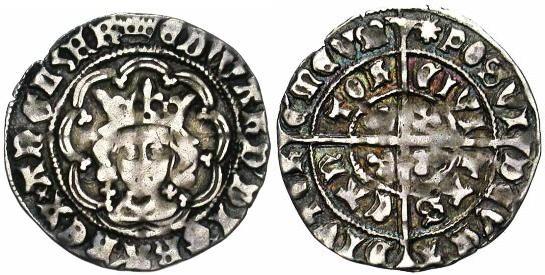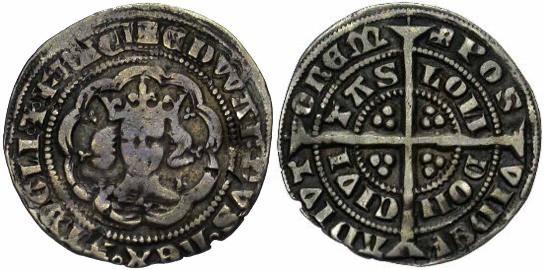
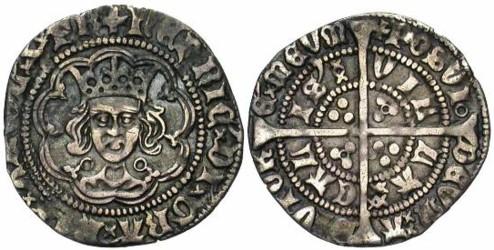
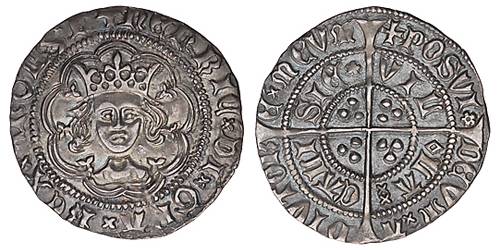
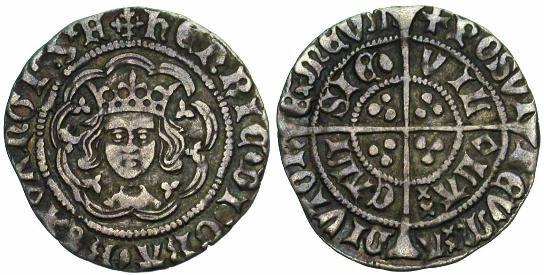
It is not thought that any Edward V half-groats have survived, although it is known that some were minted. Richard III half-groats are very rare.
The first major change took place during the reign of Henry VII, when a profile bust of the king was shown in much greater detail than the stylised portraits of earlier issues.
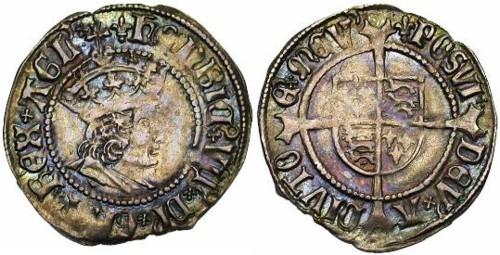
After Henry VIII's second coinage the silver was debased, and most of the output during Edward VI's reign used Henry's portrait.
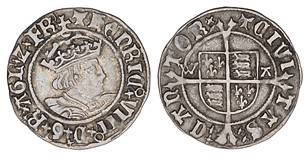
Half-groats of Elizabeth I can be distinguished from similar threepence coins by the lack of a rose behind the Queen's head.
There was a design change in 1604 during the reign of James I, where the King's portrait was replaced by a crowned rose, with a crowned thistle on the reverse.
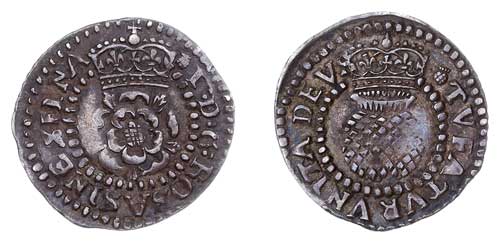
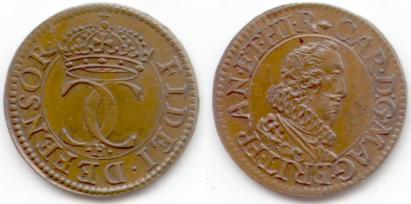
During the reign of Charles I Briot produced a pattern that in silver saw some circulation. A rare copper version is illustrated.
Charles II continued the use of interlocking C's, while James II had a crown over the roman numeral II, which is also a play on his initial - the J and I were effectively the same character at that time.
Ever since 1689 the reverse has shown a crowned numeral 2.
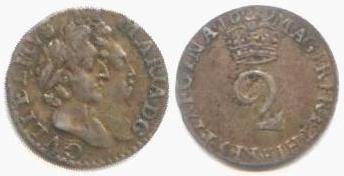
The last issues for general circulation took place during the reign of George III, although some may have been struck for colonial use. However, the denomination is still struck as part of the Maundy coinage.
The present Maundy coin weighs 0.9 g and is 13 mm diameter.
Copper Twopence
In 1797, during the reign of George III, the Cartwheel Twopence piece was struck by Matthew Boulton at the Soho Mint.
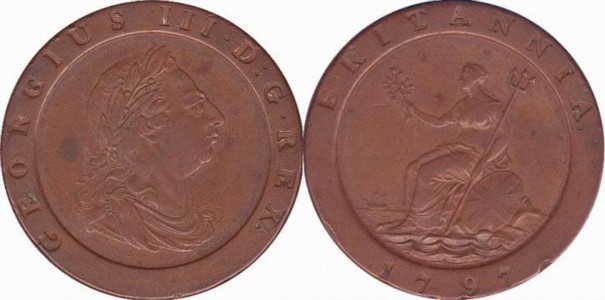
This is by far the largest base metal coin issued in the UK, weighing two ounces (56.7 g) and measuring 41 mm diameter and 5 mm thick. On the obverse is a portrait of George III facing right, with the inscription GEORGIUS III D G REX, while the reverse shows Britannia seated facing left, holding an olive branch and trident, with BRITANNIA above and 1797 below. I am grateful to Jeff for the images.
The weight means that the coin is very susceptable to edge knocks.
The coin was found to be too heavy for regular use, and no more copper or bronze twopence coins were struck until decimalisation in 1971.
There are many late strikes made by Matthew Boulton in a variety of metals, and further ones made by W.J.Taylor when he bought the dies in 1848. I believe that the chief way these later issues can be distinguished is by marks resulting from die corrosion. He also produced a pattern or patterns dated 1805 with a different design.
Acknowledgements
See my Main Coins Index page for acknowledgements
Links
The Penny Halfpenny <<-- :
-->> Three Pence
Main History Index.
Values of silver Twopence from 1668 to 1795.
Values of the copper Twopence of 1797.
Values of Maundy Sets.
Values Index.
Pictures of Two Pence.
Pictures Index.
Coins of the UK - Two Pence
Copyright reserved by the author, Tony Clayton
v33 4th March 2015